
The Facebook Groups Monster: How Social Media Created an Ugly Beast in the NDIS
- Julian De Maria
- Jun 13
- 17 min read

By DHD Consultancy | June 2025
Disclaimer: This publication is for informational purposes only and does not constitute legal, financial, or professional advice. DHD Consultancy accepts no liability for actions taken based on this content. All allegations of criminal conduct referenced herein relate to matters already prosecuted, charged, or officially confirmed by law enforcement agencies and government bodies. DHD Consultancy is committed to accuracy. If you identify any factual errors, please get in touch with us for correction.
The Facebook Groups Monster - NDIS Facebook groups have become a breeding ground for exploitation.
Let's Jump In (NDIS Facebook Groups)
There is a monster growing in the NDIS. It does not lurk in dark alleyways or hide behind shell companies in offshore jurisdictions. It lives in plain sight, within the very spaces created to help people. Facebook groups, those digital town squares where participants, families, and providers were supposed to connect, share advice, and find trustworthy support, have mutated into something far more sinister. What began as grassroots community hubs has become a cesspool of exploitation, where vulnerable Australians are treated like prey, where fear is packaged and sold as consultancy, where anyone with a laptop can declare themselves a software developer and harvest sensitive disability data, and where providers fight over participants like seagulls scrambling for hot chips at a beach picnic.
I am on roughly one hundred NDIS-related Facebook groups. I have watched them evolve from genuine support networks into something that resembles a digital Wild West, unregulated, toxic, and profoundly dangerous to the very people the NDIS was designed to protect. This is not hyperbole. The evidence is everywhere, documented in government audits, court proceedings, regulatory enforcement actions, and the daily wreckage that plays out in these public forums for anyone with the stomach to watch.
What follows is not a gentle critique. It is an unflinching exposé of how Facebook groups have created and nurtured an ugly beast in the NDIS market, one that feeds on fear, exploits trust, and enriches itself at the expense of participants and ethical providers alike. The government is finally waking up to pieces of this problem, but the full picture has never been laid bare until now.
Part I: The Consultant Industrial Complex: Fear Sold by the Kilogram
Walk into any NDIS provider Facebook group on any given day, and you will see the same performance repeated with mechanical precision. A consultant, often with a freshly minted Facebook business page and a profile photo that screams "corporate credibility", posts some variation of the following: "URGENT: New NDIS registration rules are coming. If you don't get registered NOW and buy our policy pack, you WILL fail your audit and lose your business." The post inevitably includes a link to a $2,500 "complete compliance package" consisting of generic policy templates downloaded from the internet and rebranded with a logo.
This is not advice. This is fear-based marketing, and it has become the dominant business model in NDIS consultancy.
The NDIS Quality and Safeguards Commission has been crystal clear about this problem. In its 2023-24 Annual Report, the Commission revealed that a review of over 1,500 audit reports found suspiciously identical responses in approximately 1,000 applications, suggesting widespread integrity issues in which consultants were effectively mass-producing compliant-sounding documentation without any genuine organisational assessment (DSC). Further investigation of 130 consultancy websites highlighted problematic claims of guaranteed registration and audit success, promises that no legitimate consultant can ever make, given that registration decisions rest solely with the NDIS Commission (DSC). The Commission referred these matters to the ACCC, which has since taken enforcement action against businesses making false and misleading claims about NDIS endorsement (Australian Competition and Consumer Commission).
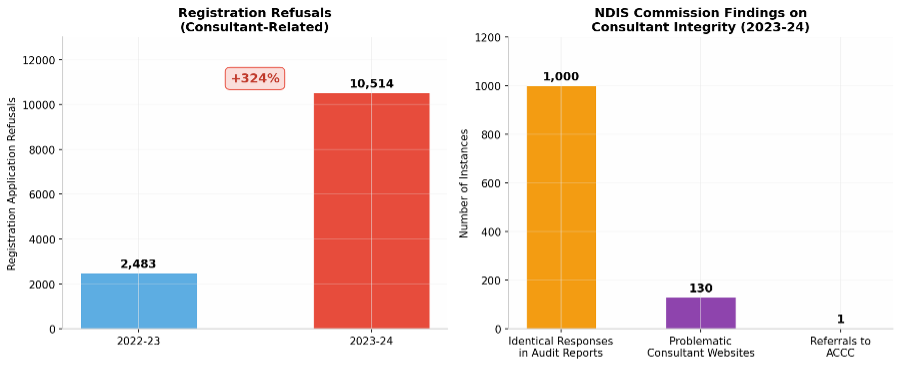
NDIS Commission findings on consultant integrity problems
The Commission's official position is unambiguous: "The NDIS Commission does not regulate or endorse consultants, and providers must be cautious when relying on external advisors." It specifically warns that some consultants may provide incorrect or misleading advice, overpromise guaranteed registration or audit approvals, charge excessive fees for unnecessary services, lack an understanding of NDIS regulations, and encourage shortcuts that could result in deregistration. Yet these warnings are routinely drowned out in Facebook groups where consultants outnumber informed participants ten to one.
The business model is devastatingly effective. A new provider, often a well-meaning disability support worker who has decided to go out on their own, joins a Facebook group seeking guidance. They are immediately bombarded with posts warning of impending regulatory doom. The language is always apocalyptic: "mandatory registration is coming for everyone" (partly true, but the timeline and scope are deliberately distorted), "the Commission is cracking down and you need to act immediately" (enforcement is increasing, but the urgency is manufactured), and "our clients never fail audits, we guarantee it" (a claim that should trigger immediate alarm bells, since no one can guarantee an audit outcome) (vccg.com.au).
The NDIS Commission's own data suggests this is systemic. Registration application refusals jumped from 2,483 in 2022-23 to 10,514 in 2023-24, a 324% increase, with the Commission explicitly linking this surge to "concerns about consultants acting on behalf of applicants through the registration application process" (DSC). These are not marginal problems. They represent a fundamental corruption of the registration pathway, facilitated by an unregulated consultancy market that operates with near-total impunity in social media spaces.
Part II: The Software Developer Gold Rush: Data Sovereignty Sold to the Highest Bidder
If the consultancy explosion represents one side of the Facebook group coin, the other side is the proliferation of NDIS software applications. This industry has materialised seemingly overnight, promising to solve every administrative headache with a slick interface and a monthly subscription fee. Scroll through any NDIS provider group, and you will find dozens of posts from "software developers" advertising new platforms for rostering, billing, participant management, progress notes, and plan tracking. Everyone, it seems, has built an NDIS app. And almost nobody is asking the questions that matter most.
Where is participant data stored? Who has access to it? What cybersecurity protections are in place? What happens when, not if, these platforms are breached?
The disability sector has already experienced a catastrophic warning shot. In May 2022, the CTARS cloud platform, a client management system used by NDIS care providers, suffered a significant data breach. The personal information of approximately 12,000 individuals was compromised, including dates of birth, email addresses, personal health data, phone numbers, physical addresses, and usernames (Twingat). The data was subsequently posted to an online hacking forum. This was not a sophisticated nation-state attack. It was a predictable consequence of inadequate security practices in a sector where data protection has historically been treated as an afterthought.
The CTARS breach should have triggered a sector-wide reckoning. Instead, it seems to have been largely forgotten, even as the number of NDIS software platforms has exploded. The NDIA itself has actively encouraged this proliferation through its Digital Partnership Program (DPP), which publishes APIs and invites developers to "build apps and other tools that connect into the NDIA" (National Disability Insurance Scheme (NDIS)). The program aims to create "a competitive market of developers all building creative solutions." On paper, this sounds progressive. In practice, it has created a data sovereignty nightmare.
Electronic Frontiers Australia has been ringing alarm bells about this for years. In a 2026 Statement of Concern, EFA highlighted that the introduction of the PACE system, which stores sensitive participant data offshore in Salesforce's German data centre, raises "further concerns about the increased risk of a data breach arising from the offshoring of personal data" (efa.org.au). Freedom of Information requests revealed that the NDIA has "struggled to provide proof of data security assurances," leaving critical questions unanswered about whether Australian disability data is adequately protected in foreign jurisdictions (efa.org.au).
The myNDIS app compounds these concerns. Participants are being pressured to use an application that collects "extensive personal and sensitive data, including navigation and identity verification information," with data sharing with Services Australia framed as essential (efa.org.au). The app's privacy assurances are deliberately vague, promising only to take "reasonable steps" for data security without concrete commitments to encryption or regular security reviews. As EFA notes: "In all, it looks like cyber-washing." (efa.org.au)
The sector's broader cybersecurity posture is equally alarming. According to the Digital Technology in the Not-for-Profit Sector Report 2024, 57% of NDIS and not-for-profit organisations do not have multi-factor authentication on systems holding sensitive information, and only 20% conduct regular cybersecurity training for staff and volunteers. One in five NDIS providers has no cybersecurity strategy in place wtechability.net.au) These are organisations handling some of the most vulnerable personal data in Australia, medical histories, behavioural notes, disability types, care needs, home addresses, and financial information, and they are doing so with security practices that would embarrass a suburban takeaway shop.
Every new software developer that enters the NDIS market through a Facebook group advertisement represents another potential attack vector. Every new platform that promises to "streamline your NDIS billing" is another repository of sensitive data that may or may not be adequately secured. And because these developers operate in an effectively unregulated space, the NDIS Commission does not assess software security before platforms enter the market, and providers have no reliable way to distinguish legitimate platforms from digital time bombs.
Facebook groups facilitate this by creating an environment in which social proof replaces due diligence. A consultant recommends a software platform. A provider in the group vouches for it. Three more providers sign up. None of them has conducted a security assessment. None of them has verified where the data is stored. None of them has reviewed the platform's compliance with the Notifiable Data Breaches Scheme or the Australian Privacy Principles. The group dynamics create a false sense of safety that collapses the moment a breach occurs, at which point the same group will be flooded with posts asking, "Has anyone else had their data leaked?", followed by silence from the developers, who have already moved on to their next product.
Part III: The Seagulls are comming: Providers Treating Participants Like Prey
Perhaps the most viscerally disturbing transformation of NDIS Facebook groups has been the emergence of open provider-to-participant solicitations. This phenomenon would have been unthinkable in the scheme's early years but is now routine. In groups intended for community support and advice, providers routinely post advertisements for their services, often using language that would be considered predatory in any other context.
The playbook is depressingly consistent. A provider joins a participant-focused Facebook group, often under the guise of being a "helpful resource", and begins posting regularly. The posts start innocuously enough: educational content about NDIS plans, tips for self-management, answers to common questions. But the subtext is always commercial. "Feel free to message me if you need support coordination services." "We have vacancies in our SIL homes, DM for details." "Specialising in plan management for participants who want hassle-free claiming."
Industry marketing guides actually formalise this approach. One prominent NDIS marketing blog advises providers to "join local NDIS groups on Facebook" and "engage with the administrators to tell them that you're not looking to spam. Once they let you in, engage with the members. Write some thoughtful comments. Get to know people. But more importantly, deliver value with your posts". Another guide explicitly recommends "social media, without a doubt" as the best way to reach self-managed participants, noting that "Facebook groups are one of the best places to engage with NDIS participants that are actively looking for services".
The problem is not marketing per se. The problem is that Facebook groups blur the line between community support and commercial predation, disadvantaging the most vulnerable. A newly diagnosed participant, overwhelmed by the complexity of their first NDIS plan, joins a Facebook group seeking peer advice. Instead of finding unbiased guidance from people with lived experience, they encounter a wall of providers trained to "deliver value" as a lead-generation strategy. The participant cannot distinguish between genuine community support and sophisticated marketing. The power imbalance is profound and deeply exploitative.
The ACCC has documented this problem extensively. In its February 2026 report on consumer issues in the NDIS, the Commission identified false and misleading advertising as the most common type of NDIS-related complaint (Australian Competition and Consumer Commission). Common breaches include using expressions such as "NDIS approved" when the NDIS does not approve products or services, suggesting the NDIS covers holidays and recreational activities that are ineligible, and using NDIS logos or branding to suggest endorsement (LMS TRG). The ACCC has taken enforcement action against multiple businesses, including Bedshed ($39,600 in penalties for advertising mattresses as "NDIS approved") and Thermomix ($79,200 for claiming products were "NDIS-registered") (National Disability Insurance Scheme (NDIS)).
But the ACCC's enforcement actions barely scratch the surface of what occurs in Facebook groups, where the vast majority of problematic conduct is too diffuse and informal to trigger regulatory action. A provider who slides into a participant's DMs after a supportive comment in a group is not technically breaking any law, but they are exploiting a vulnerability inherent in the group structure. The participant is seeking community; the provider is seeking a revenue source. This is not a fair transaction, and it happens thousands of times every day across the NDIS Facebook ecosystem.
The groups also facilitate price gouging and discriminatory pricing that the ACCC has identified as a major concern. The NDIS Code of Conduct explicitly prohibits charging participants higher prices for the same products or services than non-NDIS participants (Australian Competition and Consumer Commission). Yet in Facebook groups, providers routinely discuss pricing strategies that effectively treat NDIS participants as cash cows, "NDIS rates" that bear no relationship to market value, inflated invoicing practices, and advice on maximising claims within plan limits. The groups create an environment where these practices are normalised, discussed openly, and passed on to new providers as "standard industry practice."
Part IV: The Public Colosseum: Fights, Allegations, and Fraud in Open Forums
If the commercial exploitation were not bad enough, NDIS Facebook groups have also become public colosseums where providers fight each other, air grievances, make allegations, and engage in behaviour that would be considered defamatory if it occurred anywhere other than a Facebook comment thread. The toxicity is extraordinary, and it is entirely public, permanently archived, and searchable.
I have watched providers accuse each other of fraud in group posts that remain visible to thousands of members. I have seen allegations of criminal conduct aired without evidence, personal attacks on business owners, false reviews posted by competitors posing as dissatisfied clients, and coordinated harassment campaigns organised through private messages but executed in public forums. The groups have become places where reputations are destroyed in hours, where unproven allegations are treated as fact, and where the line between whistleblowing and character assassination has been obliterated.
This is not harmless drama. The NDIS Commission's 2023-24 Annual Report documented a 78% increase in complaints and a 47% increase in reportable incidents year-on-year, and that is just the conduct that reaches formal channels (Dhd Consultancy). The vast majority of disputes that play out in Facebook groups never trigger regulatory action, but they cause real harm to businesses, workers, and participants who are caught in the crossfire.
The public nature of these conflicts creates particular risks for participants. When providers fight in open forums, participant privacy is routinely compromised. Names, locations, and service details are disclosed in ways that breach confidentiality obligations under the NDIS Code of Conduct. Allegations of poor service, whether proven or not, become permanently associated with participant identities through the searchability of Facebook content. A participant who complains about a provider in a group may find that complaint resurfacing years later, affecting their ability to engage with their services.
The groups also facilitate the spread of misinformation about NDIS policy and compliance requirements. A single incorrect post about registration requirements, plan management rules, or compliance obligations can be shared hundreds of times before anyone corrects it. By then, providers have already acted on bad information, purchased unnecessary services, changed their business structures, or made claims based on faulty guidance. The damage is done, and the original post remains online to mislead the next wave of readers.
The ANAO's 2025 audit of NDIA claim compliance found that the agency's frameworks are "partly effective" at best, with basic prevention controls such as identity verification and prepayment validation only commencing in 2024, a full decade after the scheme's inception (Australian National Audit Office (ANAO)). The audit estimated that fraud, non-compliance, and payment errors represented 6-10% of NDIS outlays, equating to $2.0-3.5 billion in 2022-23 and forecast to increase to $3.6-6.0 billion by 2027-28 (Australian National Audit Office (ANAO)). In early 2025, the NDIA Board was briefed that "measurable integrity losses are likely in excess of 10%", meaning the problem is getting worse, not better, despite increased enforcement activity (Australian National Audit Office (ANAO)).

NDIS fraud and payment error estimates show growing financial leakage
The Fraud Fusion Taskforce, a multi-agency body comprising 23 agencies, has launched over 635 investigations since November 2022, executed 110+ search warrants, and achieved 21 successful criminal prosecutions (National Disability Insurance Scheme (NDIS)). In late 2024, authorities uncovered up to $50 million in allegedly fraudulent claims orchestrated by organised criminal gangs, including one network that submitted claims for participants who were literally in jail at the time of alleged service delivery (National Disability Insurance Scheme (NDIS)). These are not victimless crimes. They represent the systematic theft of resources intended for Australia's most vulnerable citizens, and Facebook groups are, in many cases, the marketplace where these criminal networks recruit participants, find compliant providers, and launder their activities through seemingly legitimate businesses.
Part V: The Regulatory Awakening: Too Little, Too Late?
The government has finally recognised that the NDIS consultant and advisory market is out of control. In April 2026, the National Disability Insurance Scheme Amendment (Integrity and Safeguarding) Bill 2025 became law, delivering what NDIS Minister Jenny McAllister described as "tough new laws to protect people with a disability and safeguard the NDIS from exploitation at the hands of fraudsters, predators and shonks" (National Disability Insurance Scheme (NDIS)).
The legislation includes several measures that directly address the problems documented in this report:
New Power | What It Does | Relevance to Facebook Group Problems |
Banning of auditors and consultants | Expands banning orders to include NDIS auditors, business advisors, and consultants who give fraudulent advice (Department of Health and Aged Care) | Directly targets the fear-mongering consultants operating in Facebook groups. |
Anti-promotion orders | Restricts businesses from advertising NDIS supports in ways that undermine scheme integrity (NDIS Quality and Safeguards Commission) | Addresses false and misleading advertising by providers in social media spaces |
Increased penalties | Fines increased up to 40 times, from $412,500 to more than $15 million for serious misconduct leading to death or injury (National Disability Insurance Scheme (NDIS)) | Creates a meaningful deterrent against predatory provider behaviour |
Criminal offences | Up to 5 years imprisonment for providing unregistered supports or failing to comply with banning orders (National Disability Insurance Scheme (NDIS)) | Elevates NDIS fraud from a regulatory issue to a criminal matter |
Mandatory electronic claims | Modernises claims to prevent fraud and abuse (National Disability Insurance Scheme (NDIS)) | Reduces opportunities for invoice manipulation that is facilitated through informal provider networks |
The NDIS Quality and Safeguards Commissioner, Louise Glanville, has been explicit about the target of these reforms: "the ability to ban auditors and consultants is critical to remove unscrupulous operators from the scheme" (NDIS Quality and Safeguards Commission). She noted that "anti-promotion powers will mean we can crack down on predatory marketing that exploits NDIS participants and undermines the integrity of the scheme" (NDIS Quality and Safeguards Commission).
But here is the uncomfortable reality: these powers, while welcome, are insufficient to address the problem's scale. The legislation gives the Commission authority to ban bad actors, but only after they have been identified, investigated, and proven to have engaged in misconduct. The Facebook group ecosystem generates new " nscrupulous operators" faster than any regulator can remove them. A banned consultant can create a new Facebook profile tomorrow. A deregistered provider can reappear as an unregistered operator servicing plan-managed participants. The groups themselves, the infrastructure that enables this conduct, remain entirely unregulated.
The AACCC's taskforce into NDIS consumer harms, established in December 2023 and now operating alongside the NDIA and NDIS Commission, has referred 604 instances of concerning practices to the ACCC, 112 likely breaches of the NDIS Provider Code of Conduct to the Commission, and 6 integrity matters to the Fraud Fusion Taskforce (National Disability Insurance Scheme (NDIS)). These numbers, while significant, represent only the conduct that has been formally reported and investigated. They do not capture the daily grind of exploitation, misinformation, and predation that plays out in Facebook groups with no regulatory oversight whatsoever.

NDIS Commission compliance actions showing dramatic year-on-year increases
The AANAO's audit findings underscore just how far behind the curve regulatory action remains. The NNDIA's Crack Down on Fraud program, a $495 million initiative, did not commence until February 2024 and, as of April 2025, was reporting an "mber" status due to procurement delays that put timely delivery of milestones at risk (Australian National Audit Office (ANAO)). Basic preventive controls, such as identity verification and prepayment validation, were absent from the scheme's design and are only now being implemented. The AATO's vulnerability assessment of the NDIS identified 80 potential or actual vulnerabilities. It made 67 recommendations, yet as of April 2025, the NDIA Board had not been briefed on the findings or developed an action plan to respond (Australian National Audit Office (ANAO)).
This system is not winning the fight against exploitation. It is a system that is perpetually playing catch-up while the Facebook group monster grows larger and more sophisticated.
Part VI: What Must Happen Now: A Call for Systemic Action
Exposing the problem is necessary but insufficient. The NDIS community, participants, families, ethical providers, and advocates deserve a pathway forward. Based on our analysis, the following actions are required to address the Facebook groups monster and restore integrity to the NDIS marketplace.
1. Regulate the Consultant Market
The NDIS Commission's new banning powers are a start, but they are reactive. What is needed is proactive regulation of the consultancy market. Consultants who advise providers on NDIS compliance should be required to:
• Register with the NDIS Commission and meet minimum qualification standards
• Carry professional indemnity insurance that covers advice-related losses
• Disclose conflicts of interest, including any financial relationships with auditors, software platforms, or other service providers
• Be subject to a public complaints mechanism that allows providers to report misleading advice
The Explanatory Memorandum for the Integrity and Safeguarding Bill explicitly contemplates that banning orders could prohibit "engaging in NDIS audits and misleading or predatory provider consultancy practices" (Parliament of Australia). This language should be translated into a comprehensive registration and oversight scheme for NDIS consultants, not merely a punitive tool used after damage has been done.
2. Mandate Software Security Standards
Every NDIS software platform that handles participant data should be required to:
• Store all Australian participant data in Australian data centres, ending the offshore data sovereignty risks that EFA and others have documented
• Obtain independent cybersecurity certification (such as IRAP or ISO 27001) before being marketed to NDIS providers
• Publish transparent privacy policies that specify what data is collected, who has access, how long it is retained, and how participants can request deletion
• Report data breaches to the NDIS Commission and OAIC within mandatory timeframes
The NNDIA's Digital Partnership Program should not publish APIs to any developer who requests them. Access should be contingent on demonstrated security competence and ongoing compliance monitoring.
3. Create Safe Community Spaces
Facebook groups serve a genuine need, participants and families require peer support, and providers need information-sharing forums. But the current free-for-all model is failing. What is needed is:
• Accredited, moderated community platforms, potentially administered by the NDIS Commission or peak bodies, where membership is verified, and commercial solicitation is prohibited
• Clear separation between community support spaces and commercial marketplaces, so participants seeking advice are not simultaneously exposed to provider advertising
• Moderation standards that prevent the spread of misinformation, the airing of unsubstantiated allegations, and the harassment of group members
4. Empower Participants
The ultimate victims of the Facebook groups monster are NDIS participants, the people whose trust is exploited, whose data is compromised, and whose plans are drained by predatory operators. Participants need:
• Clear, accessible information about how to verify provider credentials and identify misleading marketing
• A simplified complaints pathway that allows them to report problematic provider conduct directly to the NDIS Commission
• Protection from retaliation when they raise concerns about providers, including legal safeguards against providers who use Facebook groups to target complainants
5. Hold Platforms Accountable
Facebook and Meta profit from the engagement these NDIS groups generate. Yet the platform accepts no responsibility for the exploitation that occurs within them. While the ACCC and NDIS Commission can take action against individual providers and consultants, there is no mechanism for holding the platform itself accountable for facilitating harmful conduct. This accountability gap should be addressed through:
• Mandatory reporting obligations for social media platforms that host NDIS-related commercial activity
• Requirements for group administrators to verify the identity of providers who join participant-focused groups
• Clearer terms of service that prohibit predatory marketing to vulnerable users
The Bottom Line
The NDIS Facebook group ecosystem has created an ugly beast, a self-reinforcing cycle of fear, exploitation, and misinformation that enriches bad actors while harming the very people the scheme was designed to support. Consultants sell fear to vulnerable providers. Software developers harvest sensitive data without adequate safeguards. Providers treat participants as revenue targets in spaces that masquerade as community support. And all of it plays out in public forums where regulatory oversight is minimal, and accountability is virtually nonexistent.
The government's new legislative powers are a necessary first step, but they will not be sufficient. The Facebook groups monster feeds on opacity, anonymity, and the absence of professional standards. Starving it requires systemic reform of the consultancy market, software security requirements, community platform governance, and the regulatory frameworks that have allowed this problem to fester for years.
At DHD Consultancy, we have watched this evolution with growing alarm. We have seen good providers, committed, ethical, participant-centred organisations, driven to despair by the toxic environment in these groups. We have seen participants exploited by operators who should never have been allowed near the scheme. And we have seen the NNDIS's reputation dragged through the mud by a thousand small cuts, each one delivered via a Facebook post, a direct message, or a "helpful" comment from someone whose primary interest is profit, not people.
The NDIS is too important to be destroyed by its own marketplace. The Facebook groups monster must be confronted, exposed, and dismantled. The reforms outlined above provide a roadmap. What is needed now is the political will, regulatory courage, and sector-wide commitment to make them happen.
The alternative, allowing this ecosystem to continue unchecked, is the slow, degrading collapse of public trust in Australia's most ambitious social reform. And that is a price that none of us can afford to pay.
About DHD Consultancy
DHD Consultancy is a Brisbane-based NDIS consultancy firm specialising in provider registration, compliance, quality auditing, and governance. We work with providers across Queensland to navigate the NDIS regulatory landscape with integrity, accuracy, and an unwavering commitment to participant outcomes. We do not sell fear. We do not promise guaranteed audit outcomes. And we do not harvest participant data. We do the hard work of genuine compliance because participants deserve nothing less.
If you have witnessed or experienced exploitation in NDIS Facebook groups, we encourage you to report it to the NDIS Commission at ndiscommission.gov.au or the ACCC at accc.gov.au.


Comments